
Poster corner pin
Four corner handles project an original fluorescent poster onto an oblique concrete wall, with one action to restore its fit.
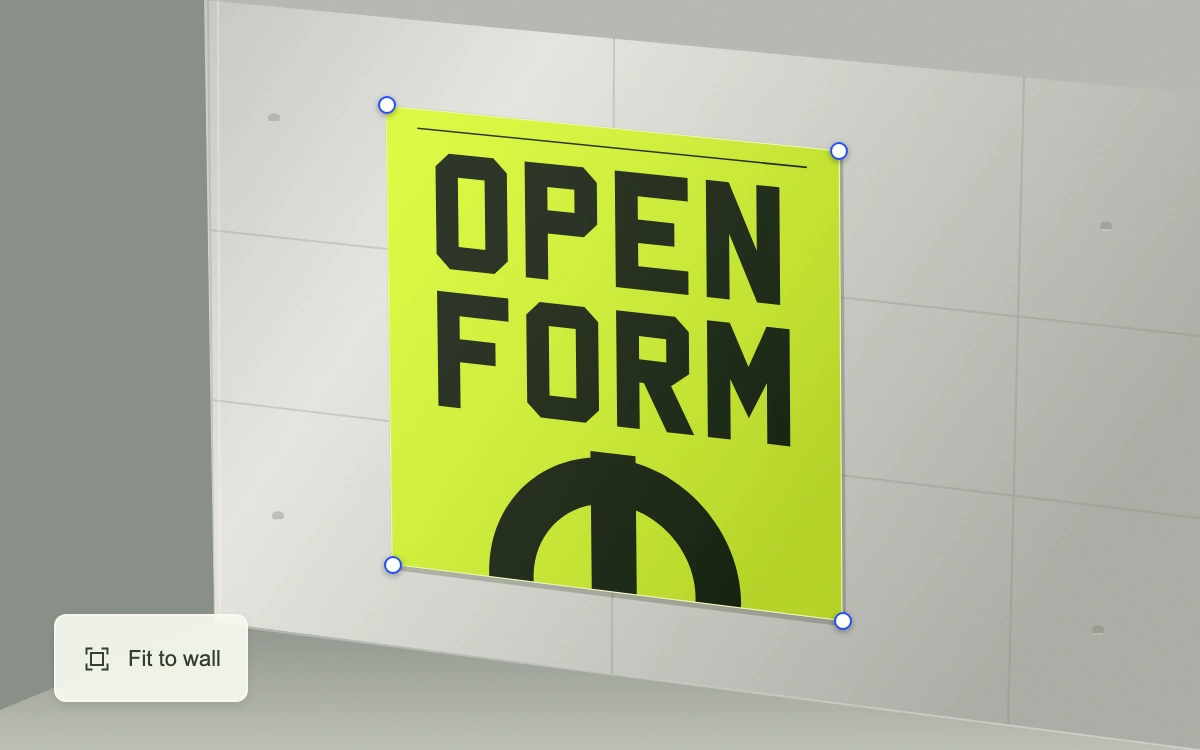
Drag a poster corner, nudge it with arrow keys, or choose Fit to wall.
Subframe Original · MIT
Add to your project
Component source
Standalone React component. Styles are included.
React only. No additional packages.
Render the default export inside a container with a defined height. Its optional active prop stops movement when false. This example works with React 19; Next.js projects can use it as a client component.
View source code
/**
 * MIT License
 *
 * Copyright (c) 2026 Subframe
 *
 * Permission is hereby granted, free of charge, to any person obtaining a copy
 * of this software and associated documentation files (the "Software"), to deal
 * in the Software without restriction, including without limitation the rights
 * to use, copy, modify, merge, publish, distribute, sublicense, and/or sell
 * copies of the Software, and to permit persons to whom the Software is
 * furnished to do so, subject to the following conditions:
 *
 * The above copyright notice and this permission notice shall be included in all
 * copies or substantial portions of the Software.
 *
 * THE SOFTWARE IS PROVIDED "AS IS", WITHOUT WARRANTY OF ANY KIND, EXPRESS OR
 * IMPLIED, INCLUDING BUT NOT LIMITED TO THE WARRANTIES OF MERCHANTABILITY,
 * FITNESS FOR A PARTICULAR PURPOSE AND NONINFRINGEMENT. IN NO EVENT SHALL THE
 * AUTHORS OR COPYRIGHT HOLDERS BE LIABLE FOR ANY CLAIM, DAMAGES OR OTHER
 * LIABILITY, WHETHER IN AN ACTION OF CONTRACT, TORT OR OTHERWISE, ARISING FROM,
 * OUT OF OR IN CONNECTION WITH THE SOFTWARE OR THE USE OR OTHER DEALINGS IN THE
 * SOFTWARE.
 */

"use client"

import { useId, useRef, useState } from "react"
type Point = { x: number; y: number }
// Solve the eight projective coefficients from four point correspondences.
function matrix(points: Point[]) {
  const source = [
      [0, 0],
      [100, 0],
      [100, 100],
      [0, 100],
    ],
    a: number[][] = []
  points.forEach((p, i) => {
    const [x, y] = source[i]
    a.push([x, y, 1, 0, 0, 0, -p.x * x, -p.x * y, p.x], [0, 0, 0, x, y, 1, -p.y * x, -p.y * y, p.y])
  })
  for (let col = 0; col < 8; col++) {
    let pivot = col
    for (let row = col + 1; row < 8; row++) if (Math.abs(a[row][col]) > Math.abs(a[pivot][col])) pivot = row
    ;[a[col], a[pivot]] = [a[pivot], a[col]]
    const d = a[col][col]
    if (Math.abs(d) < 1e-8) return [1, 0, 0, 0, 1, 0, 0, 0]
    for (let k = col; k < 9; k++) a[col][k] /= d
    for (let row = 0; row < 8; row++) {
      if (row === col) continue
      const f = a[row][col]
      for (let k = col; k < 9; k++) a[row][k] -= f * a[col][k]
    }
  }
  return a.map((r) => r[8])
}

// A moved corner stays inside the intersection of the four positive-turn half-planes.
// The area margin also keeps the homography away from a nearly collapsed edge.
function moveCorner(points: Point[], index: number, x: number, y: number) {
  const candidate = points.map((point, i) =>
    i === index
      ? {
          x: Math.max(i === 0 || i === 3 ? 140 : 335, Math.min(i === 0 || i === 3 ? 265 : 465, x)),
          y: Math.max(i < 2 ? 30 : 225, Math.min(i < 2 ? 135 : 335, y)),
        }
      : point,
  )
  const turn = (quad: Point[], i: number) => {
    const a = quad[i],
      b = quad[(i + 1) % 4],
      c = quad[(i + 2) % 4]
    return (b.x - a.x) * (c.y - b.y) - (b.y - a.y) * (c.x - b.x)
  }
  const minimumTurnArea = 4000
  let travel = 1
  for (let i = 0; i < 4; i++) {
    const from = turn(points, i),
      to = turn(candidate, i)
    if (to < minimumTurnArea) travel = Math.min(travel, Math.max(0, (from - minimumTurnArea) / (from - to)))
  }
  if (travel < 1) travel = Math.max(0, travel - 1e-9)
  return points.map((point, i) =>
    i === index
      ? {
          x: point.x + (candidate[i].x - point.x) * travel,
          y: point.y + (candidate[i].y - point.y) * travel,
        }
      : point,
  )
}

// Clip in source space: artwork beyond the sheet can cross a projective horizon
// even when the visible target quadrilateral is convex.
function clipArtwork(polygon: number[][]) {
  let clipped = polygon
  for (const [axis, edge, direction] of [
    [0, 0, 1],
    [0, 100, -1],
    [1, 0, 1],
    [1, 100, -1],
  ]) {
    const input = clipped
    clipped = []
    if (!input.length) break
    let previous = input[input.length - 1]
    let previousDistance = direction * (previous[axis] - edge)
    for (const point of input) {
      const distance = direction * (point[axis] - edge)
      if (distance >= 0 !== previousDistance >= 0) {
        const fraction = previousDistance / (previousDistance - distance)
        clipped.push([
          previous[0] + (point[0] - previous[0]) * fraction,
          previous[1] + (point[1] - previous[1]) * fraction,
        ])
      }
      if (distance >= 0) clipped.push(point)
      previous = point
      previousDistance = distance
    }
  }
  return clipped
}

const wall = [
  { x: 102, y: 0 },
  { x: 600, y: 47 },
  { x: 600, y: 375 },
  { x: 107, y: 311 },
]
const wallMatrix = matrix(wall)
const fitted = [
  [19, 14],
  [65, 14],
  [65, 87],
  [19, 87],
].map(([x, y]) => {
  const d = wallMatrix[6] * x + wallMatrix[7] * y + 1
  return {
    x: (wallMatrix[0] * x + wallMatrix[1] * y + wallMatrix[2]) / d,
    y: (wallMatrix[3] * x + wallMatrix[4] * y + wallMatrix[5]) / d,
  }
})
const glyphs: Record<string, number[][][]> = {
  O: [
    [
      [3, 0],
      [13, 0],
      [16, 3],
      [16, 22],
      [13, 25],
      [3, 25],
      [0, 22],
      [0, 3],
    ],
    [
      [5, 5],
      [5, 20],
      [11, 20],
      [11, 5],
    ],
  ],
  P: [
    [
      [0, 0],
      [13, 0],
      [16, 3],
      [16, 12],
      [13, 15],
      [5, 15],
      [5, 25],
      [0, 25],
    ],
    [
      [5, 5],
      [5, 10],
      [11, 10],
      [11, 5],
    ],
  ],
  E: [
    [
      [0, 0],
      [16, 0],
      [16, 5],
      [5, 5],
      [5, 10],
      [13, 10],
      [13, 15],
      [5, 15],
      [5, 20],
      [16, 20],
      [16, 25],
      [0, 25],
    ],
  ],
  N: [
    [
      [0, 0],
      [5, 0],
      [11, 14],
      [11, 0],
      [16, 0],
      [16, 25],
      [11, 25],
      [5, 11],
      [5, 25],
      [0, 25],
    ],
  ],
  F: [
    [
      [0, 0],
      [16, 0],
      [16, 5],
      [5, 5],
      [5, 10],
      [13, 10],
      [13, 15],
      [5, 15],
      [5, 25],
      [0, 25],
    ],
  ],
  R: [
    [
      [0, 0],
      [13, 0],
      [16, 3],
      [16, 12],
      [12, 15],
      [17, 25],
      [11, 25],
      [6, 15],
      [5, 15],
      [5, 25],
      [0, 25],
    ],
    [
      [5, 5],
      [5, 10],
      [11, 10],
      [11, 5],
    ],
  ],
  M: [
    [
      [0, 0],
      [5, 0],
      [9, 9],
      [13, 0],
      [18, 0],
      [18, 25],
      [13, 25],
      [13, 12],
      [9, 20],
      [5, 12],
      [5, 25],
      [0, 25],
    ],
  ],
}
export default function PerspectivePin({ active = true }: { active?: boolean }) {
  const [points, setPoints] = useState(fitted)
  const id = useId(),
    stage = useRef<HTMLDivElement>(null),
    drag = useRef<{ corner: number; pointer: number; dx: number; dy: number } | null>(null)
  const h = matrix(points)
  const project = (x: number, y: number) => {
    const d = h[6] * x + h[7] * y + 1
    return { x: (h[0] * x + h[1] * y + h[2]) / d, y: (h[3] * x + h[4] * y + h[5]) / d }
  }
  const path = (ps: number[][]) => {
    const clipped = clipArtwork(ps)
    if (clipped.length < 3) return ""
    return (
      clipped
        .map(([x, y], i) => {
          const p = project(x, y)
          return `${i ? "L" : "M"}${p.x},${p.y}`
        })
        .join(" ") + "Z"
    )
  }
  const ring = (r: number) =>
    Array.from({ length: 129 }, (_, i) => {
      const a = (i / 128) * Math.PI * 2
      return [50 + Math.cos(a) * r, 99 + Math.sin(a) * r]
    })
  const changed = points.some((p, i) => Math.abs(p.x - fitted[i].x) + Math.abs(p.y - fitted[i].y) > 0.1)
  const update = (i: number, x: number, y: number) => setPoints((ps) => moveCorner(ps, i, x, y))
  return (
    <div className="sf-cornerpin" data-active={active} ref={stage}>
      <svg
        className="sf-cornerpin-art"
        viewBox="0 0 600 375"
        aria-label="Original Open Form poster fitted to an oblique concrete wall"
        role="img"
      >
        <defs>
          <linearGradient id={`${id}-wall`} x1="0" y1="0" x2="1" y2=".5">
            <stop stopColor="#c7c8c4" />
            <stop offset=".3" stopColor="#e6e7e1" />
            <stop offset="1" stopColor="#abada5" />
          </linearGradient>
          <linearGradient id={`${id}-floor`} x1="0" y1="0" x2="0" y2="1">
            <stop stopColor="#8f958b" />
            <stop offset="1" stopColor="#bcc0b5" />
          </linearGradient>
          <linearGradient id={`${id}-shade`} x1="0" y1="0" x2="1" y2=".7">
            <stop stopColor="#fff" stopOpacity=".1" />
            <stop offset="1" stopColor="#0c2000" stopOpacity=".18" />
          </linearGradient>
          <clipPath id={`${id}-print`}>
            <path
              d={path([
                [0, 0],
                [100, 0],
                [100, 100],
                [0, 100],
              ])}
            />
          </clipPath>
          <filter id={`${id}-texture`} x="0" y="0" width="100%" height="100%">
            <feTurbulence type="fractalNoise" baseFrequency=".78" numOctaves="3" seed="8" />
            <feColorMatrix type="saturate" values="0" />
            <feComponentTransfer>
              <feFuncA type="linear" slope=".08" />
            </feComponentTransfer>
            <feBlend in="SourceGraphic" mode="multiply" />
          </filter>
        </defs>
        <rect width="600" height="375" fill="#b5b9b1" />
        <path d="M102 0 600 47V375L107 311Z" fill={`url(#${id}-wall)`} />
        <path d="M0 355 107 311 600 375H0Z" fill={`url(#${id}-floor)`} />
        <path d="M102 0 107 311 0 355V0Z" fill="#888e85" />
        <path
          d="m105 115 495 53m-494 32 494 59M104 0l3 311M307 19l-1 318m206-299-8 324"
          fill="none"
          stroke="#727b68"
          strokeOpacity=".23"
          strokeWidth="1"
        />
        <path d="m109 0 1 312 490 63" stroke="#ffffff" strokeOpacity=".3" fill="none" />
        <g opacity=".35" fill="#757d70">
          {[
            [137, 59],
            [139, 258],
            [336, 88],
            [334, 283],
            [553, 113],
            [549, 315],
          ].map(([x, y]) => (
            <g key={x}>
              <ellipse cx={x} cy={y} rx="3" ry="2.4" />
              <path d={`M${x - 2} ${y + 2}h4`} stroke="#f8f9f2" strokeWidth=".7" />
            </g>
          ))}
        </g>
        <rect width="600" height="375" fill="transparent" filter={`url(#${id}-texture)`} />
        <polygon
          points={fitted.map((p) => `${p.x},${p.y}`).join(" ")}
          fill="#3a422c"
          opacity=".18"
          stroke="#586044"
          strokeWidth="1"
          strokeDasharray={changed ? "4 4" : undefined}
        />
        <path
          d={path([
            [0, 0],
            [100, 0],
            [100, 100],
            [0, 100],
          ])}
          fill="#1b2b11"
          opacity=".22"
          transform="translate(2 3)"
        />
        <path
          d={path([
            [0, 0],
            [100, 0],
            [100, 100],
            [0, 100],
          ])}
          fill="#d9fa31"
        />
        <g clipPath={`url(#${id}-print)`} fill="#182212">
          {["OPEN", "FORM"].map((word, row) =>
            Array.from(word).map((letter, i) => (
              <path
                key={`${word}-${i}`}
                fillRule="evenodd"
                d={glyphs[letter].map((p) => path(p.map(([x, y]) => [x + 11 + i * 20, y + 9 + row * 30]))).join(" ")}
              />
            )),
          )}
          <path d={path(ring(28)) + " " + path(ring(18))} fillRule="evenodd" />
          <path
            d={path([
              [45, 70],
              [55, 70],
              [55, 100],
              [45, 100],
            ])}
          />
          <path
            d={path([
              [7, 4],
              [93, 4],
              [93, 4.35],
              [7, 4.35],
            ])}
          />
        </g>
        <path
          d={path([
            [0, 0],
            [100, 0],
            [100, 100],
            [0, 100],
          ])}
          fill={`url(#${id}-shade)`}
        />
        <path
          d={path([
            [0, 0],
            [100, 0],
            [100, 100],
            [0, 100],
          ])}
          fill="none"
          stroke="#eef3bc"
          strokeWidth=".6"
        />
      </svg>
      {points.map((p, i) => (
        <button
          key={i}
          type="button"
          className="sf-cornerpin-handle"
          style={{ left: `${p.x / 6}%`, top: `${p.y / 3.75}%` }}
          aria-label={`${
            ["Top left", "Top right", "Bottom right", "Bottom left"][i]
          } poster corner. Drag or use arrow keys.`}
          onPointerDown={(e) => {
            if (e.button !== 0 || drag.current) return
            e.preventDefault()
            e.currentTarget.focus()
            const r = stage.current!.getBoundingClientRect()
            drag.current = {
              corner: i,
              pointer: e.pointerId,
              dx: p.x - ((e.clientX - r.left) / r.width) * 600,
              dy: p.y - ((e.clientY - r.top) / r.height) * 375,
            }
            e.currentTarget.setPointerCapture(e.pointerId)
          }}
          onPointerMove={(e) => {
            if (drag.current?.corner !== i || drag.current.pointer !== e.pointerId) return
            const r = stage.current!.getBoundingClientRect()
            update(
              i,
              ((e.clientX - r.left) / r.width) * 600 + drag.current.dx,
              ((e.clientY - r.top) / r.height) * 375 + drag.current.dy,
            )
          }}
          onPointerUp={(event) => {
            if (drag.current?.pointer !== event.pointerId) return
            drag.current = null
          }}
          onPointerCancel={(event) => {
            if (drag.current?.pointer !== event.pointerId) return
            drag.current = null
          }}
          onLostPointerCapture={(event) => {
            if (drag.current?.pointer !== event.pointerId) return
            drag.current = null
          }}
          onKeyDown={(e) => {
            if (e.key.startsWith("Arrow")) {
              e.preventDefault()
              const step = e.shiftKey ? 10 : 2
              update(
                i,
                p.x + (e.key === "ArrowRight" ? step : e.key === "ArrowLeft" ? -step : 0),
                p.y + (e.key === "ArrowDown" ? step : e.key === "ArrowUp" ? -step : 0),
              )
            }
            if (e.key === "Escape") {
              setPoints(fitted)
              drag.current = null
            }
          }}
        >
          <i aria-hidden="true" />
        </button>
      ))}
      <button
        className="sf-cornerpin-fit"
        type="button"
        onClick={() => setPoints(fitted)}
        aria-label="Fit poster to wall"
      >
        <svg width="15" height="15" viewBox="0 0 20 20" fill="none" aria-hidden="true">
          <path d="M3 7V3h4m6 0h4v4M3 13v4h4m6 0h4v-4M6 6h8v8H6Z" stroke="currentColor" strokeWidth="1.3" />
        </svg>
        Fit to wall
      </button>
      <style>{`
.sf-cornerpin{width:100%;height:100%;position:relative;overflow:hidden;background:#c2c5b9;font-family:Arial,sans-serif}.sf-cornerpin *{box-sizing:border-box}.sf-cornerpin-art{display:block;position:absolute;inset:0;width:100%;height:100%}.sf-cornerpin-handle{position:absolute;transform:translate(-50%,-50%);width:74px;height:74px;border:0;background:transparent;padding:0;cursor:move;touch-action:none}.sf-cornerpin-handle i{position:absolute;width:9px;height:9px;left:calc(50% - 4.5px);top:calc(50% - 4.5px);background:#fbfff6;border:1.5px solid #284bfe;box-shadow:0 1px 3px #0005;border-radius:50%}.sf-cornerpin-handle:focus-visible{outline:1px solid #244cff;outline-offset:-15px;border-radius:20px}.sf-cornerpin-fit{position:absolute;left:27px;bottom:24px;display:flex;gap:8px;align-items:center;height:44px;padding:0 13px;border:1px solid #f9faf3aa;background:#f5f7edee;color:#333e2d;border-radius:6px;box-shadow:0 2px 4px #2030101a;font-size:11px;cursor:pointer;transition:background 120ms ease,transform 120ms ease}.sf-cornerpin-fit:active{transform:scale(.97)}.sf-cornerpin-fit:focus-visible{outline:2px solid #244cff;outline-offset:3px}@media(hover:hover){.sf-cornerpin-fit:hover{background:#fff}}.sf-cornerpin[data-active=false] *{transition:none}@media(prefers-reduced-motion:reduce){.sf-cornerpin *{transition:none}}
`}</style>
    </div>
  )
}
Where it works well
Place vector artwork on a photographed or rendered surface using direct corner manipulation rather than matrix fields.
Reduced motion
Corner edits follow input directly. Fit to wall restores the exact target geometry without an animated warp.
Things to know
Bounded corner movement also enforces a positive signed-turn margin to prevent concave, self-crossing or nearly collapsed quadrilaterals. Wall and poster are original SVG, including outlined lettering. No image upload or camera calibration.