
Contour terrain
Slowly shifting elevation bands carve warm paper into a layered topographic relief.
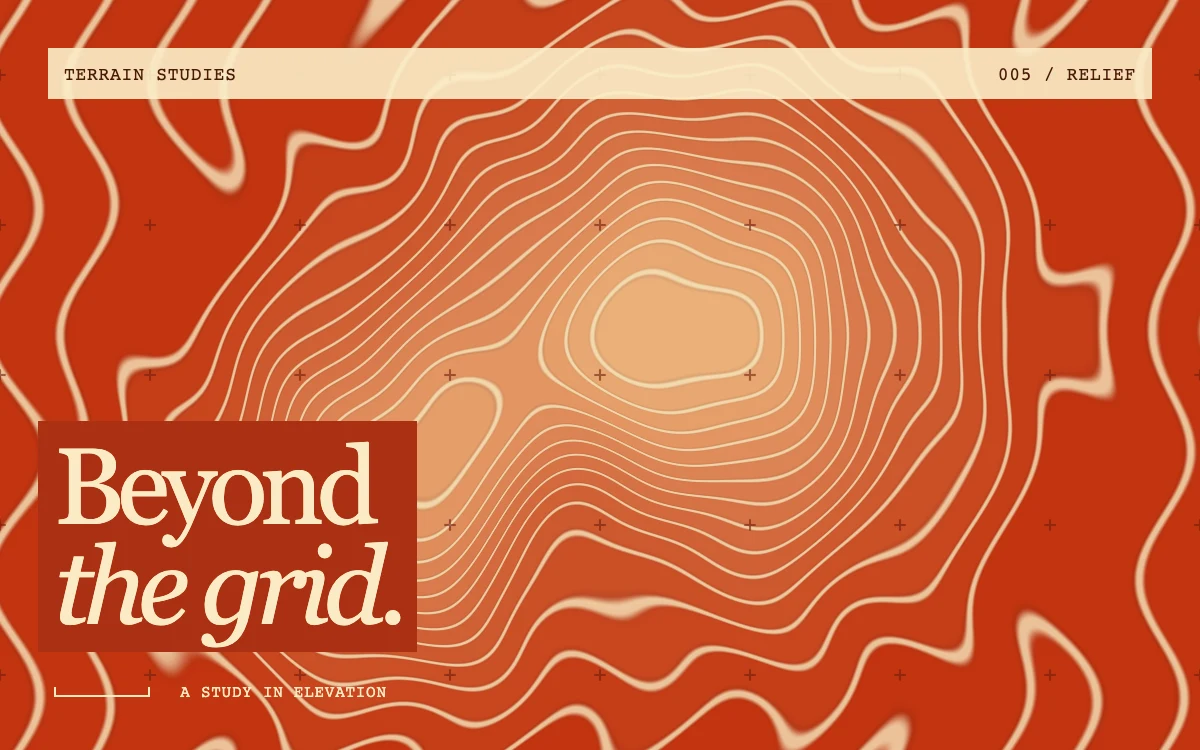
Play or pause the material study.
Subframe Original · MIT
Add to your project
Component source
Standalone React component. Styles are included.
React only. No additional packages.
Render the default export inside a container with a defined height. Its optional active prop stops movement when false. This example works with React 19; Next.js projects can use it as a client component.
View source code
"use client"

/*
 * Copyright (c) 2026 Subframe
 *
 * Permission is hereby granted, free of charge, to any person obtaining a copy
 * of this software and associated documentation files (the "Software"), to deal
 * in the Software without restriction, including without limitation the rights
 * to use, copy, modify, merge, publish, distribute, sublicense, and/or sell
 * copies of the Software, and to permit persons to whom the Software is
 * furnished to do so, subject to the following conditions:
 * The above copyright notice and this permission notice shall be included in all
 * copies or substantial portions of the Software.
 * THE SOFTWARE IS PROVIDED "AS IS", WITHOUT WARRANTY OF ANY KIND, EXPRESS OR
 * IMPLIED, INCLUDING BUT NOT LIMITED TO THE WARRANTIES OF MERCHANTABILITY,
 * FITNESS FOR A PARTICULAR PURPOSE AND NONINFRINGEMENT. IN NO EVENT SHALL THE
 * AUTHORS OR COPYRIGHT HOLDERS BE LIABLE FOR ANY CLAIM, DAMAGES OR OTHER
 * LIABILITY, WHETHER IN AN ACTION OF CONTRACT, TORT OR OTHERWISE, ARISING FROM,
 * OUT OF OR IN CONNECTION WITH THE SOFTWARE OR THE USE OR OTHER DEALINGS IN THE
 * SOFTWARE.
 */

import { useEffect, useRef, useState } from "react"

const FRAGMENT = `
precision highp float;
uniform vec2 u_resolution;
uniform float u_time;

float terrain(vec2 p) {
  p += .045 * vec2(sin(u_time * .17), cos(u_time * .13));
  float a = exp(-dot(p - vec2(.22,.12), p - vec2(.22,.12)) * 4.0);
  float b = .72 * exp(-dot(p - vec2(-.4,-.2), p - vec2(-.4,-.2)) * 7.5);
  float valley = .37 * exp(-dot(p - vec2(-.02,-.25), p - vec2(-.02,-.25)) * 18.0);
  return a + b - valley + .027 * sin(p.x * 18.0 + sin(p.y * 12.0));
}
void main() {
  vec2 p = (gl_FragCoord.xy - .5 * u_resolution) / min(u_resolution.x, u_resolution.y);
  float altitude = terrain(p * 1.6);
  float band = floor(altitude * 15.0) / 15.0;
  float edge = fract(altitude * 15.0);
  float contour = 1.0 - smoothstep(.024, .115, min(edge, 1.0 - edge));
  float shade = smoothstep(.06, .19, edge) * (1.0 - smoothstep(.84,.98,edge));
  vec3 orange = vec3(.76,.205,.062);
  vec3 sand = vec3(.98,.87,.63);
  vec3 color = mix(orange, sand, clamp(band * .78, 0.0, .9));
  color *= .9 + .1 * shade;
  color = mix(color, vec3(.99,.92,.75), contour * .78);
  vec2 marks = abs(fract(p * 5.0 + .5) - .5);
  float cross = (1.0 - smoothstep(.005,.011,marks.x)) * (1.0 - smoothstep(.035,.04,marks.y));
  cross = max(cross, (1.0 - smoothstep(.005,.011,marks.y)) * (1.0 - smoothstep(.035,.04,marks.x)));
  color = mix(color, vec3(.44,.11,.045), cross * .6);
  gl_FragColor = vec4(color, 1.0);
}
`

export default function ContourTerrainExample({ active = true }: { active?: boolean }) {
  const canvasRef = useRef<HTMLCanvasElement>(null)
  const runningRef = useRef(active)
  const syncRef = useRef<() => void>(() => {})
  const timeRef = useRef(3)
  const contextLeaseRef = useRef(0)
  const [paused, setPaused] = useState(false)
  const [available, setAvailable] = useState(false)
  const [reduced, setReduced] = useState(false)
  runningRef.current = active && !paused

  useEffect(() => {
    const canvas = canvasRef.current
    if (!canvas) return
    const gl = canvas.getContext("webgl", { alpha: false, antialias: false, powerPreference: "low-power" })
    if (!gl) return
    const lease = ++contextLeaseRef.current
    let disposed = false
    let frame = 0
    let last = 0
    let lost = false
    const preference = window.matchMedia("(prefers-reduced-motion: reduce)")
    let reduce = preference.matches
    setReduced(reduce)
    const shaders: WebGLShader[] = []
    const compile = (type: number, code: string) => {
      const shader = gl.createShader(type)
      if (!shader) return null
      shaders.push(shader)
      gl.shaderSource(shader, code)
      gl.compileShader(shader)
      return gl.getShaderParameter(shader, gl.COMPILE_STATUS) ? shader : null
    }
    const vertex = compile(
      gl.VERTEX_SHADER,
      "attribute vec2 a_position; void main(){gl_Position=vec4(a_position,0.0,1.0);}",
    )
    const fragment = compile(gl.FRAGMENT_SHADER, FRAGMENT)
    const program = gl.createProgram()
    const buffer = gl.createBuffer()
    if (!vertex || !fragment || !program || !buffer) {
      shaders.forEach((shader) => gl.deleteShader(shader))
      gl.deleteProgram(program)
      gl.deleteBuffer(buffer)
      gl.getExtension("WEBGL_lose_context")?.loseContext()
      return
    }
    gl.attachShader(program, vertex)
    gl.attachShader(program, fragment)
    gl.linkProgram(program)
    if (!gl.getProgramParameter(program, gl.LINK_STATUS)) {
      shaders.forEach((shader) => gl.deleteShader(shader))
      gl.deleteProgram(program)
      gl.deleteBuffer(buffer)
      gl.getExtension("WEBGL_lose_context")?.loseContext()
      return
    }
    gl.useProgram(program)
    gl.bindBuffer(gl.ARRAY_BUFFER, buffer)
    gl.bufferData(gl.ARRAY_BUFFER, new Float32Array([-1, -1, 1, -1, -1, 1, -1, 1, 1, -1, 1, 1]), gl.STATIC_DRAW)
    const position = gl.getAttribLocation(program, "a_position")
    gl.enableVertexAttribArray(position)
    gl.vertexAttribPointer(position, 2, gl.FLOAT, false, 0, 0)
    const resolution = gl.getUniformLocation(program, "u_resolution")
    const time = gl.getUniformLocation(program, "u_time")
    const draw = () => {
      if (disposed || lost) return
      gl.uniform2f(resolution, canvas.width, canvas.height)
      gl.uniform1f(time, reduce ? 3 : timeRef.current)
      gl.drawArrays(gl.TRIANGLES, 0, 6)
    }
    const tick = (now: number) => {
      if (disposed || lost || reduce || !runningRef.current || document.hidden) {
        frame = 0
        last = 0
        return
      }
      if (last) timeRef.current += Math.min((now - last) / 1000, 0.05)
      last = now
      draw()
      frame = requestAnimationFrame(tick)
    }
    const sync = () => {
      cancelAnimationFrame(frame)
      frame = 0
      last = 0
      if (disposed || lost) return
      draw()
      if (runningRef.current && !reduce && !document.hidden) frame = requestAnimationFrame(tick)
    }
    const resize = () => {
      const { width, height } = canvas.getBoundingClientRect()
      if (!width || !height) return
      // Size the drawing buffer from displayed pixels, including ancestor scale.
      const ratio = Math.min(window.devicePixelRatio || 1, 2, Math.sqrt(3600000 / (width * height)))
      const nextWidth = Math.max(1, Math.round(width * ratio))
      const nextHeight = Math.max(1, Math.round(height * ratio))
      if (canvas.width === nextWidth && canvas.height === nextHeight) return
      canvas.width = nextWidth
      canvas.height = nextHeight
      gl.viewport(0, 0, canvas.width, canvas.height)
      draw()
    }
    const updatePreference = () => {
      reduce = preference.matches
      setReduced(reduce)
      sync()
    }
    const contextLost = (event: Event) => {
      event.preventDefault()
      lost = true
      cancelAnimationFrame(frame)
      setAvailable(false)
    }
    // Keep the static artwork after context loss. Remount to create fresh GPU resources.
    canvas.addEventListener("webglcontextlost", contextLost)
    preference.addEventListener("change", updatePreference)
    document.addEventListener("visibilitychange", sync)
    const observer = new ResizeObserver(resize)
    // ResizeObserver alone cannot see a transform on the preview composition.
    const transforms = new MutationObserver(resize)
    for (let node: HTMLElement | null = canvas; node; node = node.parentElement) {
      observer.observe(node)
      transforms.observe(node, { attributes: true, attributeFilter: ["style", "class"] })
    }
    window.addEventListener("resize", resize)
    syncRef.current = sync
    resize()
    setAvailable(true)
    sync()
    const releaseContext = () => {
      if (contextLeaseRef.current === lease) gl.getExtension("WEBGL_lose_context")?.loseContext()
    }
    return () => {
      disposed = true
      cancelAnimationFrame(frame)
      syncRef.current = () => {}
      observer.disconnect()
      transforms.disconnect()
      window.removeEventListener("resize", resize)
      canvas.removeEventListener("webglcontextlost", contextLost)
      preference.removeEventListener("change", updatePreference)
      document.removeEventListener("visibilitychange", sync)
      gl.deleteBuffer(buffer)
      gl.deleteProgram(program)
      shaders.forEach((shader) => gl.deleteShader(shader))
      // Defer context release so React Strict Mode can reacquire this canvas.
      queueMicrotask(releaseContext)
    }
  }, [])

  useEffect(() => {
    syncRef.current()
  }, [active, paused])

  return (
    <div
      className="sg-contour-terrain"
      style={{
        position: "relative",
        isolation: "isolate",
        width: "100%",
        height: "100%",
        minHeight: 240,
        overflow: "hidden",
        containerType: "inline-size",
        background: "#c34520",
        color: "#fbebc4",
      }}
    >
      <div className="sg-contour-terrain-fallback" aria-hidden="true" />
      <canvas
        ref={canvasRef}
        aria-hidden="true"
        style={{ position: "absolute", inset: 0, width: "100%", height: "100%", opacity: available ? 1 : 0 }}
      />
      <span className="sg-contour-terrain-top">
        TERRAIN STUDIES <span>005 / RELIEF</span>
      </span>
      <div className="sg-contour-terrain-title">
        Beyond
        <br />
        <em>the grid.</em>
      </div>
      <span className="sg-contour-terrain-scale">
        <i /> A STUDY IN ELEVATION
      </span>
      {available && !reduced && (
        <button
          className="sg-contour-terrain-pause"
          type="button"
          disabled={!active}
          aria-label={paused ? "Play animation" : "Pause animation"}
          onClick={() => setPaused((value) => !value)}
        >
          {paused ? "Play" : "Pause"}
        </button>
      )}
      <style>{`
.sg-contour-terrain *{box-sizing:border-box}
.sg-contour-terrain-fallback{position:absolute;inset:0;background:repeating-radial-gradient(ellipse at 62% 43%,#f4d49c 0 14px,#d8753a 15px 25px,#b13713 26px 28px)}
.sg-contour-terrain-pause{position:absolute;right:22px;bottom:18px;padding:7px 9px;border:1px solid currentColor;border-radius:0;font:10px/1 monospace;color:#fbebc4;background:#c34520;cursor:pointer;min-width:44px;min-height:44px;opacity:.9}
.sg-contour-terrain-pause:focus-visible{outline:2px solid currentColor;outline-offset:3px}
.sg-contour-terrain-pause:disabled{opacity:.5;cursor:default}

.sg-contour-terrain-top{position:absolute;left:24px;right:24px;top:24px;display:flex;justify-content:space-between;gap:12px;font:9px/1.3 monospace;letter-spacing:.04em;color:#491b0a;background:#fbecc7e8;padding:7px 8px}
.sg-contour-terrain-title{position:absolute;left:27px;bottom:57px;font:clamp(42px,9cqw,60px)/.92 Georgia,serif;letter-spacing:-.065em;background:#aa3013;box-shadow:0 0 0 8px #aa3013}
.sg-contour-terrain-title em{font-weight:400}
.sg-contour-terrain-scale{position:absolute;left:27px;bottom:25px;display:flex;align-items:center;gap:10px;font:8px/1 monospace;letter-spacing:.045em}
.sg-contour-terrain-scale i{width:48px;height:5px;border:1px solid currentColor;border-top:0}

      `}</style>
    </div>
  )
}
Where it works well
Outdoor identities, geography stories, architecture portfolios, or an editorial cover with dimensional texture.
Reduced motion
Displays one stable, representative frame. Responds immediately when the system preference changes.
Things to know
Requires WebGL 1; a static CSS composition remains visible when WebGL is unavailable or lost. A generative relief, not geographic data. Contour edges redraw in the fragment shader.