
Porcelain candling
A warm backlight passes through an ivory vessel's thinner walls while the unlit side stays opaque.
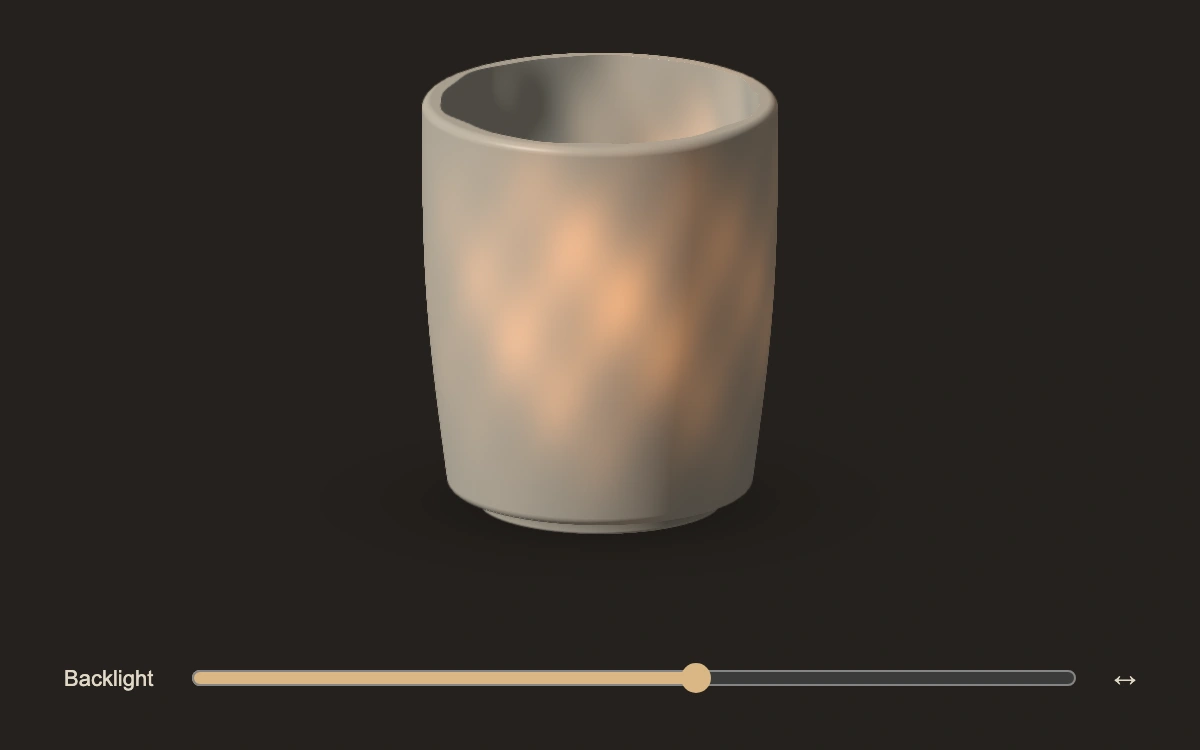
Drag the backlight across the vessel or use the Backlight slider.
Subframe Original · MIT
Add to your project
Component source
Standalone React component. Styles are included.
React only. No additional packages.
Render the default export inside a container with a defined height. Its optional active prop stops movement when false. This example works with React 19; Next.js projects can use it as a client component.
View source code
"use client"

/**
 * MIT License
 * Copyright (c) 2026 Subframe
 * Permission is hereby granted, free of charge, to any person obtaining a copy of
 * this software and associated documentation files (the "Software"), to deal in
 * the Software without restriction, including without limitation the rights to
 * use, copy, modify, merge, publish, distribute, sublicense, and/or sell copies
 * of the Software, and to permit persons to whom the Software is furnished to do
 * so, subject to the following conditions: The above copyright notice and this
 * permission notice shall be included in all copies or substantial portions of
 * the Software. THE SOFTWARE IS PROVIDED "AS IS", WITHOUT WARRANTY OF ANY KIND,
 * EXPRESS OR IMPLIED, INCLUDING BUT NOT LIMITED TO THE WARRANTIES OF
 * MERCHANTABILITY, FITNESS FOR A PARTICULAR PURPOSE AND NONINFRINGEMENT. IN NO
 * EVENT SHALL THE AUTHORS OR COPYRIGHT HOLDERS BE LIABLE FOR ANY CLAIM, DAMAGES
 * OR OTHER LIABILITY, WHETHER IN AN ACTION OF CONTRACT, TORT OR OTHERWISE,
 * ARISING FROM, OUT OF OR IN CONNECTION WITH THE SOFTWARE OR THE USE OR OTHER
 * DEALINGS IN THE SOFTWARE.
 */

import { useEffect, useRef, useState } from "react"

export const DEFAULT_CONFIG = { wallThickness: 3, lightRadius: 0.15, absorption: 1.4 }

const FRAGMENT = `
precision highp float;
uniform vec2 u_resolution;
uniform float u_wall,u_radius,u_absorption,u_lightX,u_lightY;

float hash(vec3 p) { return fract(sin(dot(p,vec3(127.1,311.7,74.7)))*43758.5453); }
float box(vec3 p,vec3 b,float radius) {
  vec3 q=abs(p)-b+radius;
  return length(max(q,0.))+min(max(q.x,max(q.y,q.z)),0.)-radius;
}
mat2 turn(float a) { return mat2(cos(a),-sin(a),sin(a),cos(a)); }
vec3 encode(vec3 c) { return pow(max(c,0.),vec3(1./2.2)); }

float thicknessField(vec3 p) {
  float angle=atan(p.x,p.z);
  return .78+.16*sin(angle*7.+p.y*7.)+.09*sin(angle*13.-p.y*11.)+.12*cos(p.y*3.);
}
float vessel(vec3 p) {
  float radius=.56+.065*(p.y+.8)+.025*cos(p.y*2.5);
  vec2 outer=vec2(length(p.xz)-radius,abs(p.y)-.74);
  float shell=length(max(outer,0.))+min(max(outer.x,outer.y),0.)-.035;
  float inner=radius-u_wall*.017*thicknessField(p);
  float cavity=max(length(p.xz)-inner,-p.y-.615);
  float cup=max(shell,-cavity);
  vec2 foot=vec2(length(p.xz)-.465,abs(p.y+.79)-.035);
  float footRing=length(max(foot,0.))+min(max(foot.x,foot.y),0.)-.012;
  return min(cup,footRing);
}
vec3 normalAt(vec3 p) {
  const float e=.0008;
  return normalize(vec3(vessel(p+vec3(e,0,0))-vessel(p-vec3(e,0,0)),vessel(p+vec3(0,e,0))-vessel(p-vec3(0,e,0)),vessel(p+vec3(0,0,e))-vessel(p-vec3(0,0,e))));
}
void main() {
  vec2 uv=(gl_FragCoord.xy-.5*u_resolution)/u_resolution.y;uv.y-=.11;
  vec3 eye=vec3(1.8,1.45,4.7),rd=normalize(-eye),right=normalize(cross(rd,vec3(0,1,0))),up=cross(right,rd);
  vec3 ro=eye+(right*uv.x+up*uv.y)*2.9;
  float t=0.;bool hit=false;
  for(int i=0;i<110;i++) {float d=vessel(ro+rd*t);if(d<.00065){hit=true;break;}t+=max(d*.72,.0004);if(t>8.)break;}
  vec3 color=vec3(.009,.0075,.0065);
  float floorT=(-.84-ro.y)/rd.y;
  if(floorT>0.) {
    vec3 p=ro+rd*floorT;
    float contact=exp(-dot(p.xz,p.xz)*3.);
    color=vec3(.014,.011,.0085)*(1.-.75*contact);
  }
  if(hit) {
    vec3 p=ro+rd*t,n=normalAt(p);
    vec3 key=normalize(vec3(-3.,4.,4.));
    float diffuse=max(dot(n,key),0.);
    float occlusion=clamp(vessel(p+n*.07)/.07,.15,1.);
    vec3 ivory=vec3(.72,.66,.54);
    float mark=0.;
    vec3 lamp=vec3(u_lightX,u_lightY,-.85);
    vec3 toLight=normalize(lamp-p);
    float backlight=pow(max(dot(-n,toLight),0.),.8);
    float falloff=exp(-dot(p.xy-lamp.xy,p.xy-lamp.xy)/pow(.33+u_radius,2.));
    float wall=u_wall*thicknessField(p);
    float transmitted=exp(-wall*u_absorption*.40)*falloff*backlight;
    float rim=pow(1.-max(dot(n,-rd),0.),3.);
    vec3 halfVector=normalize(key-rd);
    float spec=pow(max(dot(n,halfVector),0.),75.)*.18;
    color=ivory*(.10+.62*diffuse)*(.48+.52*occlusion)+spec;
    color+=vec3(1.,.40,.11)*transmitted*2.1*(1.-mark*.85);
    color+=vec3(.19,.12,.065)*rim*max(dot(n,normalize(vec3(-1,2,-3))),0.);
    color*=.99+.02*hash(floor(p*1100.));
  }
  gl_FragColor=vec4(encode(color),1.);
}
`

const EDGE_FRAGMENT = `
precision highp float;
uniform sampler2D u_image;
uniform vec2 u_size;
void main() {
  vec2 uv=gl_FragCoord.xy/u_size,pixel=1./u_size;
  vec3 center=texture2D(u_image,uv).rgb;
  vec3 nw=texture2D(u_image,uv+pixel*vec2(-1,1)).rgb;
  vec3 ne=texture2D(u_image,uv+pixel*vec2(1,1)).rgb;
  vec3 sw=texture2D(u_image,uv+pixel*vec2(-1,-1)).rgb;
  vec3 se=texture2D(u_image,uv+pixel*vec2(1,-1)).rgb;
  vec3 weights=vec3(.299,.587,.114);
  float a=dot(nw,weights),b=dot(ne,weights),c=dot(sw,weights),d=dot(se,weights),middle=dot(center,weights);
  float lo=min(middle,min(min(a,b),min(c,d))),hi=max(middle,max(max(a,b),max(c,d)));
  if(hi-lo<.035){gl_FragColor=vec4(center,1);return;}
  vec2 tangent=vec2(c+d-a-b,a+c-b-d);
  float stabilizer=max((a+b+c+d)*.03125,.008);
  tangent=clamp(tangent/(min(abs(tangent.x),abs(tangent.y))+stabilizer),-3.,3.)*pixel;
  vec3 inner=.5*(texture2D(u_image,uv-tangent/6.).rgb+texture2D(u_image,uv+tangent/6.).rgb);
  vec3 outer=.5*inner+.25*(texture2D(u_image,uv-tangent*.5).rgb+texture2D(u_image,uv+tangent*.5).rgb);
  float test=dot(outer,weights);
  gl_FragColor=vec4(test<lo||test>hi?inner:outer,1);
}
`

function bounded(value: number | undefined, fallback: number, min: number, max: number) {
  return Number.isFinite(value) ? Math.max(min, Math.min(max, value as number)) : fallback
}

function useSurface(uniforms: Record<string, number>, active: boolean, followKey = "", followMs = 0) {
  const canvas = useRef<HTMLCanvasElement>(null)
  const live = useRef({ uniforms, active, followKey, followMs })
  const request = useRef<() => void>(() => {})
  const lease = useRef(0)
  const [available, setAvailable] = useState(false)
  live.current = { uniforms, active, followKey, followMs }

  useEffect(() => {
    const element = canvas.current
    if (!element) {
      return
    }
    const gl = element.getContext("webgl", { alpha: false, antialias: false, powerPreference: "low-power" })
    if (!gl) {
      return
    }
    const leaseOwner = lease
    const currentLease = ++leaseOwner.current
    let program: WebGLProgram | null = null
    let buffer: WebGLBuffer | null = null
    let edgeProgram: WebGLProgram | null = null
    let texture: WebGLTexture | null = null
    let target: WebGLFramebuffer | null = null
    let targetWidth = 0
    let targetHeight = 0
    let edgeSize: WebGLUniformLocation | null = null
    let edgeImage: WebGLUniformLocation | null = null
    let mainPosition = 0
    let edgePosition = 0
    let shaders: WebGLShader[] = []
    let locations: Record<string, WebGLUniformLocation | null> = {}
    let frame = 0
    let previous = 0
    let disposed = false
    let lost = false
    let followed = live.current.uniforms[live.current.followKey] ?? 0
    const media = matchMedia("(prefers-reduced-motion: reduce)")

    const clear = () => {
      if (buffer) {
        gl.deleteBuffer(buffer)
      }
      if (program) {
        gl.deleteProgram(program)
      }
      if (edgeProgram) {
        gl.deleteProgram(edgeProgram)
      }
      if (texture) {
        gl.deleteTexture(texture)
      }
      if (target) {
        gl.deleteFramebuffer(target)
      }
      edgeProgram = null
      texture = null
      target = null
      targetWidth = 0
      targetHeight = 0
      shaders.forEach((shader) => gl.deleteShader(shader))
      buffer = null
      program = null
      shaders = []
    }
    const paint = () => {
      if (disposed || lost || !program) {
        return
      }
      gl.bindFramebuffer(gl.FRAMEBUFFER, target)
      gl.useProgram(program)
      gl.bindBuffer(gl.ARRAY_BUFFER, buffer)
      gl.enableVertexAttribArray(mainPosition)
      gl.vertexAttribPointer(mainPosition, 2, gl.FLOAT, false, 0, 0)
      gl.uniform2f(locations.u_resolution, element.width, element.height)
      for (const [key, value] of Object.entries(live.current.uniforms)) {
        gl.uniform1f(locations[key], key === live.current.followKey ? followed : value)
      }
      gl.drawArrays(gl.TRIANGLES, 0, 6)
      gl.bindFramebuffer(gl.FRAMEBUFFER, null)
      gl.useProgram(edgeProgram)
      gl.enableVertexAttribArray(edgePosition)
      gl.vertexAttribPointer(edgePosition, 2, gl.FLOAT, false, 0, 0)
      gl.activeTexture(gl.TEXTURE0)
      gl.bindTexture(gl.TEXTURE_2D, texture)
      gl.uniform1i(edgeImage, 0)
      gl.uniform2f(edgeSize, element.width, element.height)
      gl.drawArrays(gl.TRIANGLES, 0, 6)
    }
    const tick = (now: number) => {
      frame = 0
      const state = live.current
      if (disposed || lost || document.hidden || !state.active) {
        return
      }
      const target = state.uniforms[state.followKey]
      const dt = previous ? Math.min(now - previous, 48) : 16
      previous = now
      followed += (target - followed) * (1 - Math.exp(-dt / Math.max(1, state.followMs)))
      if (Math.abs(target - followed) < 0.0002) {
        followed = target
      }
      paint()
      if (followed !== target) {
        frame = requestAnimationFrame(tick)
      }
    }
    const wake = () => {
      cancelAnimationFrame(frame)
      frame = 0
      previous = 0
      const state = live.current
      if (!state.followKey || media.matches || state.followMs === 0) {
        followed = state.uniforms[state.followKey] ?? 0
      }
      paint()
      if (
        state.followKey &&
        state.active &&
        !media.matches &&
        !document.hidden &&
        followed !== state.uniforms[state.followKey]
      ) {
        frame = requestAnimationFrame(tick)
      }
    }
    const resize = () => {
      if (disposed || lost) {
        return
      }
      const rect = element.getBoundingClientRect()
      if (!rect.width || !rect.height) {
        return
      }
      const ratio = Math.min(devicePixelRatio || 1, 3, Math.sqrt(4000000 / (rect.width * rect.height)))
      const width = Math.max(1, Math.round(rect.width * ratio))
      const height = Math.max(1, Math.round(rect.height * ratio))
      if (width !== element.width || height !== element.height) {
        element.width = width
        element.height = height
      }
      if (texture && target && (targetWidth !== width || targetHeight !== height)) {
        gl.bindTexture(gl.TEXTURE_2D, texture)
        gl.texImage2D(gl.TEXTURE_2D, 0, gl.RGBA, width, height, 0, gl.RGBA, gl.UNSIGNED_BYTE, null)
        gl.bindFramebuffer(gl.FRAMEBUFFER, target)
        gl.framebufferTexture2D(gl.FRAMEBUFFER, gl.COLOR_ATTACHMENT0, gl.TEXTURE_2D, texture, 0)
        gl.bindFramebuffer(gl.FRAMEBUFFER, null)
        targetWidth = width
        targetHeight = height
      }
      gl.viewport(0, 0, width, height)
      paint()
    }
    const initialize = () => {
      clear()
      const compile = (kind: number, source: string) => {
        const shader = gl.createShader(kind)
        if (!shader) {
          return null
        }
        shaders.push(shader)
        gl.shaderSource(shader, source)
        gl.compileShader(shader)
        return gl.getShaderParameter(shader, gl.COMPILE_STATUS) ? shader : null
      }
      const vertex = compile(gl.VERTEX_SHADER, "attribute vec2 position;void main(){gl_Position=vec4(position,0.,1.);}")
      const fragment = compile(gl.FRAGMENT_SHADER, FRAGMENT)
      const edgeFragment = compile(gl.FRAGMENT_SHADER, EDGE_FRAGMENT)
      edgeProgram = gl.createProgram()
      texture = gl.createTexture()
      target = gl.createFramebuffer()
      program = gl.createProgram()
      buffer = gl.createBuffer()
      if (!vertex || !fragment || !edgeFragment || !program || !buffer || !edgeProgram || !texture || !target) {
        clear()
        setAvailable(false)
        return
      }
      gl.attachShader(program, vertex)
      gl.attachShader(program, fragment)
      gl.linkProgram(program)
      gl.attachShader(edgeProgram, vertex)
      gl.attachShader(edgeProgram, edgeFragment)
      gl.linkProgram(edgeProgram)
      if (!gl.getProgramParameter(program, gl.LINK_STATUS) || !gl.getProgramParameter(edgeProgram, gl.LINK_STATUS)) {
        clear()
        setAvailable(false)
        return
      }
      gl.useProgram(program)
      gl.bindBuffer(gl.ARRAY_BUFFER, buffer)
      gl.bufferData(gl.ARRAY_BUFFER, new Float32Array([-1, -1, 1, -1, -1, 1, -1, 1, 1, -1, 1, 1]), gl.STATIC_DRAW)
      mainPosition = gl.getAttribLocation(program, "position")
      edgePosition = gl.getAttribLocation(edgeProgram, "position")
      edgeSize = gl.getUniformLocation(edgeProgram, "u_size")
      edgeImage = gl.getUniformLocation(edgeProgram, "u_image")
      gl.bindTexture(gl.TEXTURE_2D, texture)
      gl.texParameteri(gl.TEXTURE_2D, gl.TEXTURE_MIN_FILTER, gl.LINEAR)
      gl.texParameteri(gl.TEXTURE_2D, gl.TEXTURE_MAG_FILTER, gl.LINEAR)
      gl.texParameteri(gl.TEXTURE_2D, gl.TEXTURE_WRAP_S, gl.CLAMP_TO_EDGE)
      gl.texParameteri(gl.TEXTURE_2D, gl.TEXTURE_WRAP_T, gl.CLAMP_TO_EDGE)
      locations = {}
      for (const name of ["u_resolution", ...Object.keys(live.current.uniforms)]) {
        locations[name] = gl.getUniformLocation(program, name)
      }
      resize()
      setAvailable(true)
      wake()
    }
    const contextLost = (event: Event) => {
      event.preventDefault()
      lost = true
      program = null
      edgeProgram = null
      buffer = null
      texture = null
      target = null
      shaders = []
      targetWidth = 0
      targetHeight = 0
      cancelAnimationFrame(frame)
      setAvailable(false)
    }
    const contextRestored = () => {
      lost = false
      initialize()
    }
    const visibility = () => {
      if (document.hidden) {
        cancelAnimationFrame(frame)
        frame = 0
        previous = 0
      } else {
        wake()
      }
    }
    const observer = new ResizeObserver(resize)
    const transforms = new MutationObserver(resize)
    for (let node: HTMLElement | null = element; node; node = node.parentElement) {
      observer.observe(node)
      transforms.observe(node, { attributes: true, attributeFilter: ["style", "class"] })
    }
    element.addEventListener("webglcontextlost", contextLost)
    element.addEventListener("webglcontextrestored", contextRestored)
    media.addEventListener("change", wake)
    document.addEventListener("visibilitychange", visibility)
    window.addEventListener("resize", resize)
    request.current = wake
    initialize()
    return () => {
      disposed = true
      cancelAnimationFrame(frame)
      request.current = () => {}
      observer.disconnect()
      transforms.disconnect()
      element.removeEventListener("webglcontextlost", contextLost)
      element.removeEventListener("webglcontextrestored", contextRestored)
      media.removeEventListener("change", wake)
      document.removeEventListener("visibilitychange", visibility)
      window.removeEventListener("resize", resize)
      clear()
      queueMicrotask(() => {
        if (leaseOwner.current === currentLease) {
          gl.getExtension("WEBGL_lose_context")?.loseContext()
        }
      })
    }
  }, [])

  useEffect(() => {
    request.current()
  }, [uniforms, active, followKey, followMs])
  return { canvas, available }
}

export default function PorcelainCandling({
  active = true,
  config,
}: {
  active?: boolean
  config?: Partial<typeof DEFAULT_CONFIG>
}) {
  const [light, setLight] = useState({ x: 0.16, y: 0.12 })
  const dragging = useRef(false)
  const { canvas, available } = useSurface(
    {
      u_wall: bounded(config?.wallThickness, 3, 1, 8),
      u_radius: bounded(config?.lightRadius, 0.15, 0.04, 0.35),
      u_absorption: bounded(config?.absorption, 1.4, 0.2, 3),
      u_lightX: light.x,
      u_lightY: light.y,
    },
    active,
  )
  const move = (x: number, y: number) => {
    const rect = canvas.current?.getBoundingClientRect()
    if (rect) {
      setLight({
        x: Math.max(-1.1, Math.min(1.1, ((x - rect.left - rect.width / 2) / rect.height) * 2.9)),
        y: Math.max(-0.5, Math.min(0.65, (0.5 - (y - rect.top) / rect.height) * 2.9)),
      })
    }
  }
  return (
    <section className="sf-candling" aria-label="Porcelain transmission study">
      {!available && (
        <div className="sf-candling-fallback">
          <svg viewBox="0 0 600 375" aria-hidden="true">
            <path d="M231 100q69-20 138 0l-15 154q-53 22-108 0Z" fill="#dad4c5" />
            <ellipse cx="300" cy="100" rx="69" ry="16" fill="#918a79" />
            <ellipse cx="300" cy="100" rx="63" ry="11" fill="#28251d" />
          </svg>
          <span>Interactive candling requires WebGL.</span>
        </div>
      )}
      <canvas
        ref={canvas}
        role="img"
        aria-label="An ivory vessel transmits a warm backlight through its thinner ceramic walls"
        style={{ opacity: available ? 1 : 0 }}
        onPointerDown={(event) => {
          dragging.current = true
          event.currentTarget.setPointerCapture(event.pointerId)
          move(event.clientX, event.clientY)
        }}
        onPointerMove={(event) => {
          if (dragging.current) {
            move(event.clientX, event.clientY)
          }
        }}
        onPointerUp={() => {
          dragging.current = false
        }}
        onPointerCancel={() => {
          dragging.current = false
        }}
      />
      <label className="sf-candling-control">
        <span>Backlight</span>
        <input
          aria-label="Backlight horizontal position"
          aria-description="Left and right move the light horizontally. Page Up and Page Down move it vertically."
          onKeyDown={(event) => {
            if (event.key === "PageUp" || event.key === "PageDown") {
              event.preventDefault()
              const direction = event.key === "PageUp" ? 1 : -1
              setLight((point) => ({ ...point, y: Math.max(-0.5, Math.min(0.65, point.y + direction * 0.08)) }))
            }
          }}
          type="range"
          min="-1.1"
          max="1.1"
          step="0.01"
          value={light.x}
          onChange={(event) => setLight((point) => ({ ...point, x: Number(event.target.value) }))}
        />
        <span aria-hidden="true">↔</span>
      </label>
      <style>{`.sf-candling{position:relative;isolation:isolate;width:100%;height:100%;min-height:200px;overflow:hidden;background:#181510;color:#e0d8c7;font:11px Arial,sans-serif}.sf-candling canvas,.sf-candling-fallback{position:absolute;inset:0;width:100%;height:100%}.sf-candling canvas{display:block;touch-action:none;cursor:move}.sf-candling-control{position:absolute;bottom:20px;left:32px;right:32px;display:flex;align-items:center;gap:16px;height:32px}.sf-candling-control input{flex:1;min-width:0;accent-color:#d9b784;height:28px;cursor:ew-resize}.sf-candling-control input:focus-visible{outline:2px solid #e3c89d;outline-offset:4px}.sf-candling-fallback svg{width:100%;height:100%}.sf-candling-fallback span{position:absolute;bottom:66px;left:0;right:0;text-align:center;color:#a19a8a;font-size:11px}`}</style>
    </section>
  )
}
Where it works well
Reveal material thickness and local variation in a craft or product inspection story.
Reduced motion
There is no automatic light motion. Direct input updates the stationary backlight without easing.
Things to know
An authored thickness field and exponential absorption approximation, not a physical subsurface-scattering simulation. No textures or models. Requires WebGL 1 with static original SVG fallback and context restoration.